In short: how should a company organise event transportation in Paris?
Treat it as logistics, not a list of cars. The best event transport starts from the guest list and the schedule, then matches vehicles to groups, meets delegates who fly in, staggers arrivals at the venue, keeps cars on standby through the evening and puts one transport coordinator in charge. Booked in advance at fixed fares, the movement of guests becomes a plan rather than a scramble.
A corporate event in Paris is judged on a hundred small arrivals. A gala dinner, a product launch, a board offsite, a conference with a hundred delegates: each one lives or dies on whether the right people reach the right door at the right minute, composed and on time. The venue, the catering and the programme get months of attention. Transport is often the last thing booked and the first thing noticed when it fails, because a guest standing on a kerb in the rain remembers nothing else about the evening.
This guide sets out how to plan event transportation in Paris the way a seasoned travel manager or event producer would: reading the event before booking the cars, matching the fleet to the guest list, and running the day through a single point of control. DBS EXPERIENCE has moved executives and delegations across Paris since 2009, over more than 25,000 journeys, and the detail below reflects how a Paris event actually unfolds on the ground.
Reading the event before you book the cars
Good event transport begins long before the first vehicle is confirmed. It begins with the shape of the event. How many guests, and who are they: a single principal, a board, a full delegation, a mix of VIPs and staff? Where do they arrive from, and at what hours: a private terminal at Le Bourget, a scheduled flight into CDG or Orly, a hotel in the 8th, a station? And what is the critical moment the whole day is built around: a keynote at nine, a dinner at eight, a ribbon cut on the hour?
Those answers decide everything that follows. An event with twenty guests arriving across a single afternoon needs a different plan from one with two hundred arriving in a ninety-minute window. Mapping the arrivals and departures first, before any car is booked, is what separates transport that disappears quietly into a good evening from transport that becomes the story for the wrong reasons. For executives flying in to attend, a VIP meet and greet at CDG and Orly folds the airport into the same plan.

Where the cars meet your guests, and why it matters
At an event, the meeting point is everything. A chauffeur who waits inside the arrivals hall by name, at the hotel entrance at the agreed minute, or in a marked position at the venue, turns a potential bottleneck into a quiet handover. The alternative — guests searching a crowded forecourt for a car, or a cluster of ride-hailing vehicles circling a one-way street — is exactly the friction an event is meant to avoid.
For a Paris event this matters most at two points: the welcome of guests arriving from the airport or their hotel, and the dispatch from the venue at the end of the night, when a hundred people want to leave at once. Both are solved the same way, by planning the positions and the order in advance and by holding the vehicles ready rather than summoned. The same discipline that governs an executive airport arrival, set out in our guide to the Paris airport VIP meet and greet, governs an event arrival.
Matching the fleet to the guest list
The right vehicle for an event is the one that fits the group and the occasion, not the largest or the most conspicuous. A principal arriving at a gala travels differently from a team of six moving between a conference and a dinner, and both differ from a delegation of forty that needs to reach a venue together and on time. The table below matches the common event groups to the vehicle that suits them.
| Guest group | Vehicle | Capacity | Best for |
|---|---|---|---|
| VIP or principal | Executive or Luxury Sedan | 1–3 | Gala arrivals, keynote speakers, discreet presence |
| Small team | Executive Van (V-Class) | 4–7 | Delegations with luggage, moving between sites |
| Larger delegation | Luxury Minibus | 8–20 | Conference groups arriving together |
| Full delegation | Luxury Mini-coach | 21–28 | Coordinated transfers between hotel, venue and dinner |
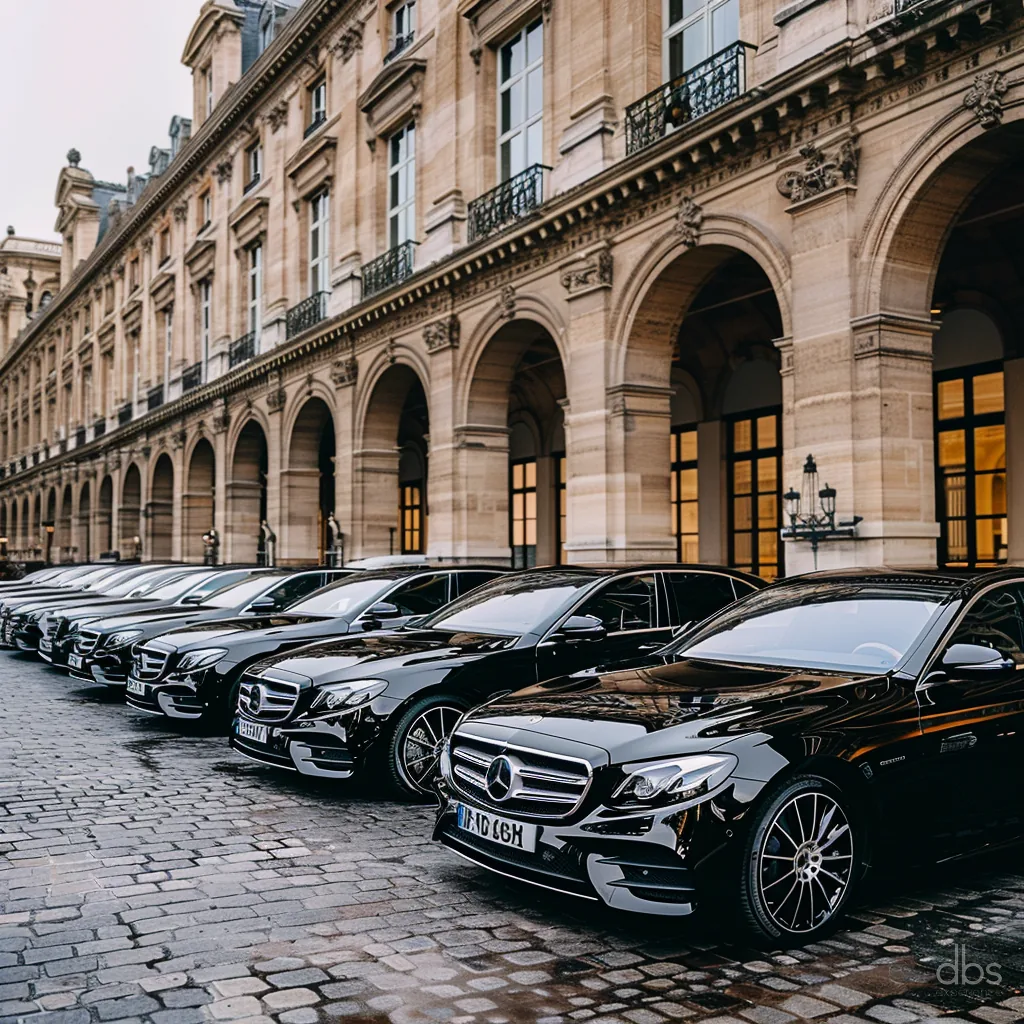
For eight to fourteen guests, two Executive Vans often serve an event better than a single larger vehicle, because they keep groups together and add resilience if one car is delayed. Larger delegations are run as a coordinated fleet rather than a string of separate bookings. The principle holds across the range: the fleet is chosen for the guest list, and choosing well is covered in our guide to corporate chauffeur service in Paris.

One point of control: the transport coordinator
The difference between a few cars and genuine event transport is coordination. On a multi-vehicle event, a transport coordinator holds the whole plan: the arrival schedule, the standby positions, the dispatch order and the live adjustments when a session overruns or a flight lands late. Guests and the event team speak to one person, and the vehicles move as a fleet rather than a set of separate bookings.
This can be an on-site coordinator present at the venue for the duration, or a full-stack coordinator managing the programme end to end, from the first airport arrival to the last car home. For a day that moves between offices and sites rather than sitting at one venue, an hourly chauffeur hire keeps a car and chauffeur with each group, and for a multi-city itinerary the same method extends into a corporate roadshow.
What event transportation costs
Event work is usually booked as hourly as-directed hire, which keeps a vehicle and chauffeur with a group for a block of time rather than a single trip. It starts from €125 per hour in a Mercedes-Benz E-Class Executive Sedan, with a four-hour minimum, and from €155 per hour in a Mercedes-Benz V-Class Executive Van for a small team or a group with luggage. An on-site transport coordinator starts from €660. Every programme is quoted as a fixed price in advance, with no meter and no surge pricing, so the transport line in the event budget is known before the day rather than discovered after it.
Building in margin: the event-day timeline
A calm event is a rehearsed one. Working backwards from the critical moment keeps the whole day comfortable rather than tight:
- Arrivals window: guests mapped to vehicles and staggered so the venue entrance is never a crush, with VIPs timed to their own slot.
- Airport legs: flights tracked, delegates met by name, fast-track used where it applies, so a late landing moves a pick-up rather than breaking the plan.
- Standby through the event: vehicles held in known positions, ready for an early departure, a sudden change or a principal who needs to leave quietly.
- Dispatch at the end: a planned order of departure so a hundred guests leave smoothly instead of competing for the same kerb.
- Margin: a reserve built into every leg, because an event has no second chance at a first impression.
The lesson repeats across every Paris event: the vehicles are rarely what goes wrong. The plan is, when there isn't one. A mapped arrival, a coordinated fleet and one person in charge keep the evening about the event, not the logistics.
Key Takeaways
- ✦Plan event transport from the guest list and the schedule first, then match vehicles to groups.
- ✦Capacity runs from a single sedan to a 28-seat mini-coach; larger groups run as one coordinated fleet.
- ✦A transport coordinator gives the event one point of control for arrivals, standby and dispatch.
- ✦Hourly as-directed hire starts from €125 per hour, quoted as a fixed price with no surge pricing.
- ✦Book a fleet at least 48 hours ahead, and earlier for large delegations or peak weeks.