In short — which vehicle should you choose?
Choose by the journey, not the badge. One to three passengers travelling around Paris or to an airport are well served by the Executive Sedan; a board-level arrival calls for the Luxury Sedan; a higher seat, heavier luggage or mixed roads point to the Luxury SUV; and four to seven people, or a team that needs to work as they travel, belong in the Executive Van. Beyond seven, a Luxury Minibus carries the group together.
Few decisions shape the feel of a journey as quietly as the car that arrives for it. For an executive stepping out of a meeting, or a travel manager arranging movement for a visiting board, the right vehicle is the one nobody has to think about: enough room, the correct presence, luggage that fits the first time. The wrong one is remembered for all the ways it did not.
DBS EXPERIENCE has run executive journeys across Paris and Île-de-France since 2009, and the pattern is consistent. The question is rarely "which is the best car" in the abstract. It is "which car for this person, this itinerary, this arrival". This guide sets out the fleet the way a chauffeur plans it: by passengers, by luggage, and by the occasion the vehicle has to carry.
Start with the journey, not the car
A chauffeur sizing a vehicle asks three things in order. How many people travel, excluding the chauffeur. How much luggage comes with them, counted in real suitcases rather than carry-ons. And what the journey is for: a working transfer, a client-facing arrival, an airport run with bags, a day of meetings across the city. Answer those three and the vehicle usually names itself. Status enters last, and only when the arrival is part of the message.
The fleet is built around that logic. Three vehicles seat one to three passengers and differ by presence and luggage; one seats four to seven and turns the cabin into a moving workspace; and for groups, a minibus keeps everyone together. Everything below follows the same order a corporate chauffeur service would use when it reads a brief.
The Executive Sedan — the default for one to three
The Executive Sedan, a Mercedes-Benz E-Class, is the vehicle most journeys do not need to improve on. It seats up to three, takes two or three suitcases, and moves through the city quietly and without fuss. For a single executive heading to a meeting, a pair travelling to a Paris airport with normal luggage, or a day of appointments on the hour, it is the measured choice: discreet, comfortable and quick to position. When nothing about the itinerary demands more, more is simply weight.
The Luxury Sedan — when the arrival is the message
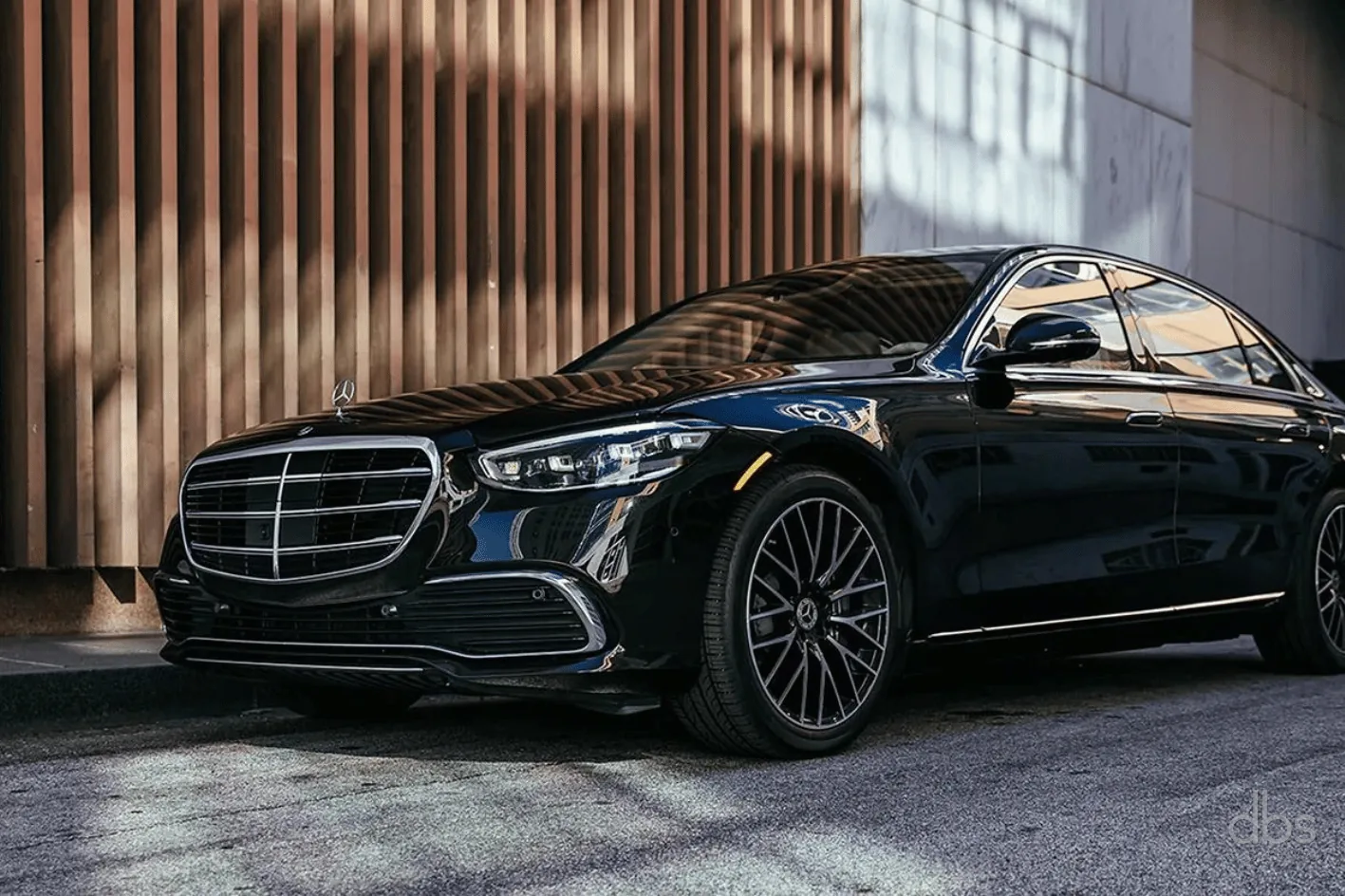
The Luxury Sedan is a long-wheelbase Mercedes-Benz S-Class or BMW 7 Series. It seats the same one to three passengers as the Executive Sedan, but the cabin is the point: more rear legroom, quieter running, a more formal line at the kerb. This is the car for a board-level arrival, a client collection where the first impression is made before a word is spoken, or a journey an executive wants to use as a quiet office between two fixed points. It does not carry more people. It carries the same people differently.
The Luxury SUV — presence, luggage and a higher seat
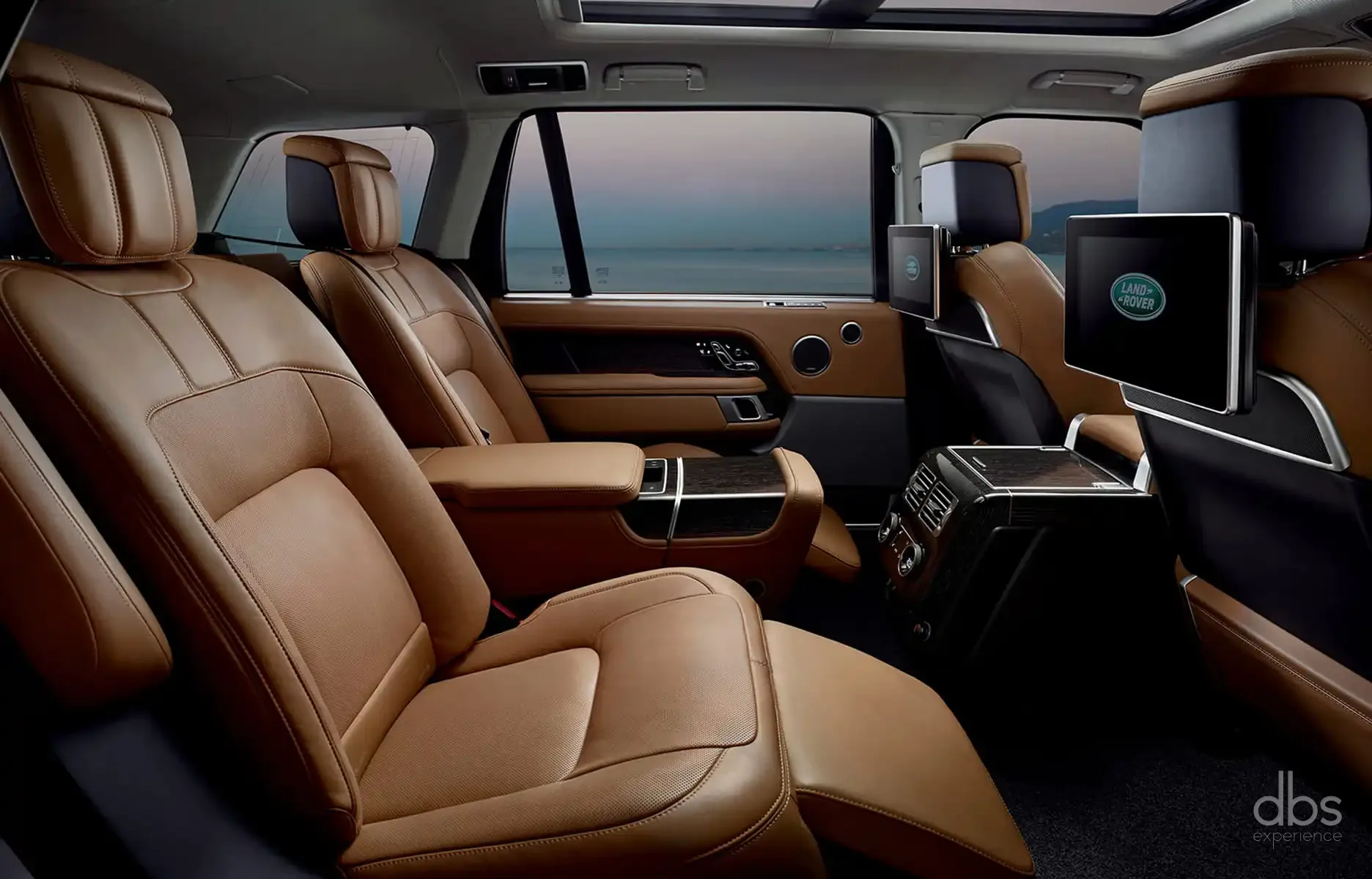
The Luxury SUV, a Range Rover Vogue Autobiography in long-wheelbase form, also seats one to three, but answers different needs: a commanding seating position, generous luggage room, and composure on an itinerary that mixes the city with longer road sections or winter conditions. It suits travellers who prefer to sit high, families with heavier bags for a day on call across the city, or an arrival where visible presence is part of the brief. In dense, narrow central streets a sedan remains the easier, quieter companion, so the SUV is a deliberate choice rather than a default.
The Executive Van — four to seven, working as they travel
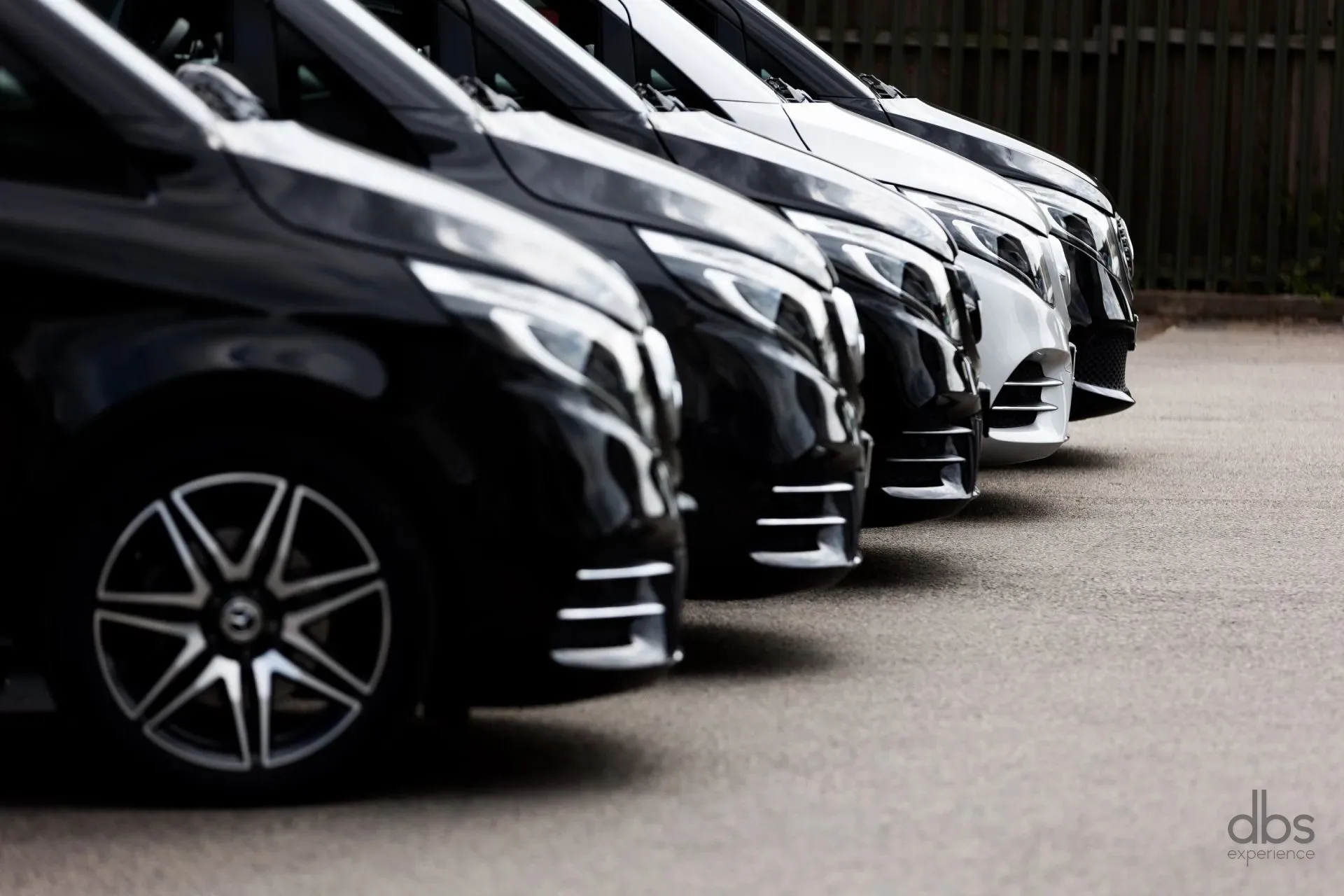
From four passengers the sedans give way to the Executive Van, a Mercedes-Benz V-Class XL seating four to seven. Its value is not only the extra seats. Individual chairs, room between them and space for luggage turn the cabin into a place where a team can talk, review a deck or decompress between meetings. For a visiting group, a family arriving together, or a project team moving between sites on a multi-stop day, the Van keeps everyone in one vehicle and one conversation. It is the quiet workhorse of corporate travel in Paris.
Beyond seven — groups, delegations and luggage
When a party grows past seven, the choice moves from comfort to logistics. A Luxury Minibus covers eight to twenty-eight passengers and keeps a delegation, an event group or a conference party together rather than split across cars. Where the luggage is the challenge rather than the headcount — a crew with equipment, or a household move between residences — a dedicated cargo vehicle travels alongside the passenger car so the cabin stays for people. The guiding rule holds: match the vehicle to what actually has to move.
| Vehicle | Passengers | Luggage | Best for |
|---|---|---|---|
| Executive Sedan — Mercedes E-Class | 1–3 | 2–3 cases | City meetings, airport runs, daily transfers |
| Luxury Sedan — Mercedes S-Class / BMW 7 Series | 1–3 | 2–3 cases | Board arrivals, client-facing journeys |
| Luxury SUV — Range Rover Autobiography | 1–3 | 3–4 cases | Presence, heavier luggage, mixed roads |
| Executive Van — Mercedes V-Class | 4–7 | 5–7 cases | Teams and families, working en route |
| Luxury Minibus — Mercedes Sprinter | 8–28 | Group | Delegations, events, roadshows |
Passenger counts are given excluding the chauffeur. The table reads top to bottom as most journeys scale: start with the Executive Sedan, step up for presence or luggage, and move to the Van or Minibus as the group grows.
What it costs
Vehicle class is the main lever on price, and every fare is fixed and agreed before the day, with no meter and no surge. As a reference point, a four-hour chauffeured booking in Paris starts from €500 in the Executive Sedan and from €620 in the seven-seat Executive Van. Airport and city transfers are quoted as fixed fares by route and vehicle, and a day on call is quoted by the hour with distance included. The sedans and SUV sit between those reference points according to class; the team confirms the exact figure for your itinerary in writing before you travel.
Matching the vehicle to the occasion
A pattern emerges once the fleet is read by use. An airport arrival for one or two with normal luggage is an Executive Sedan; the same arrival for a chairman meeting a client is a Luxury Sedan. A financial roadshow moving a small team between banks is a Van, sometimes two. A private day touring the city or heading to the vineyards leans on the SUV or the Van for luggage and comfort, while a visiting delegation is a Minibus. Our reservations team is used to reading an itinerary and proposing the vehicle before you ask, which is often the quickest way to the right answer.
Key Takeaways
- ✦Choose by passengers, luggage and occasion — in that order. The badge comes last.
- ✦One to three passengers: Executive Sedan for most journeys, Luxury Sedan for a board-level arrival, Luxury SUV for presence, luggage or mixed roads.
- ✦Four to seven: the Executive Van turns travel time into working time and keeps a team together.
- ✦Eight and above: a Luxury Minibus carries the group as one, with a cargo vehicle alongside when luggage is the constraint.
- ✦Every fare is fixed and confirmed in writing before the day, with no meter and no surge.