In short: how do you organise executive roadshow transport in Paris?
Hold a dedicated car and chauffeur, or a small matched fleet, at disposal for the whole programme rather than booking each leg separately. One managed account plans the route around the meetings, builds in buffers for the city's traffic and keeps a single point of contact for every change, so the day follows the agenda rather than the road.
A roadshow is the most demanding thing a chauffeur service is asked to do. An airport transfer has one pick-up and one drop; a roadshow has a dozen, each tied to a meeting that cannot slip, strung across a city where the distance between two addresses says little about the time between them. For an investor relations team, a corporate development office or an executive assistant briefing a principal, the transport is not a detail of the day. It is the thread that holds the day together.
DBS EXPERIENCE has run corporate and financial roadshows across Paris since 2009, over more than 25,000 journeys, and this guide sets out how the day is actually built: the single account behind it, the schedule, the fleet, the cost and the people who keep it on time.
What a roadshow asks of ground transport
A roadshow is a sequence, not a set of separate trips. The same executive or team moves from an investor meeting in the 8th to a client's headquarters at La Défense, then to a lunch on the Left Bank and a final presentation near the Opéra, all before an evening flight. Each leg depends on the one before it. A ten-minute overrun in the first meeting moves everything after it, and the transport has to absorb that without the next host ever knowing.
That is why a roadshow is booked at disposal rather than trip by trip. One car and one chauffeur are held for the whole window, the vehicle waits at the door of each meeting, and the running order lives with the chauffeur and the account manager rather than in a stack of separate reservations. The difference is not comfort. It is control over a day with no slack in it.
One account, one plan, one point of contact
The single most useful thing about a professional roadshow setup is that there is one number to call. Changes are constant on a roadshow day, a meeting runs long, an order is reversed, a car is needed an hour early, and every one of those changes should reach a person who already holds the whole plan, not a call centre starting from nothing. A managed account gives the team that single point of contact, one chauffeur or fleet briefed on the full programme, and one consolidated statement at the end rather than a dozen separate fares to reconcile.
This is the same structure that sits behind day-to-day business travel, set out on our corporate chauffeur service page, and it is formalised through a corporate account, so the roadshow and the regular travel desk work from one record and one set of terms.
Building the schedule around the meetings
A roadshow schedule is read backwards, from the last fixed commitment to the first. The team sets the meeting times; the transport plan fills the gaps between them with realistic travel windows and a margin on each. Paris rewards this discipline, because its business geography is not evenly spread.
- The 8th and the Opéra: the traditional corporate and banking core, dense and central, where the constraint is parking and setting-down rather than distance.
- La Défense: the business district to the west, quick off-peak but slow across the morning and evening peaks when the whole city is moving the same way.
- The Left Bank: the 6th and 7th, where many funds and institutions sit, reached easily from the south but awkwardly from La Défense across the river.
- The edges: Issy-les-Moulineaux, Boulogne and Neuilly, close on a map yet dependent on a handful of crossing points that decide the real time.
A chauffeur who knows these patterns does not take the shortest route; they take the one that fits the hour, and they tell the account manager early when two meetings are simply too close together to hold. That honesty at the planning stage is worth more than any speed on the day.
The fleet for a roadshow
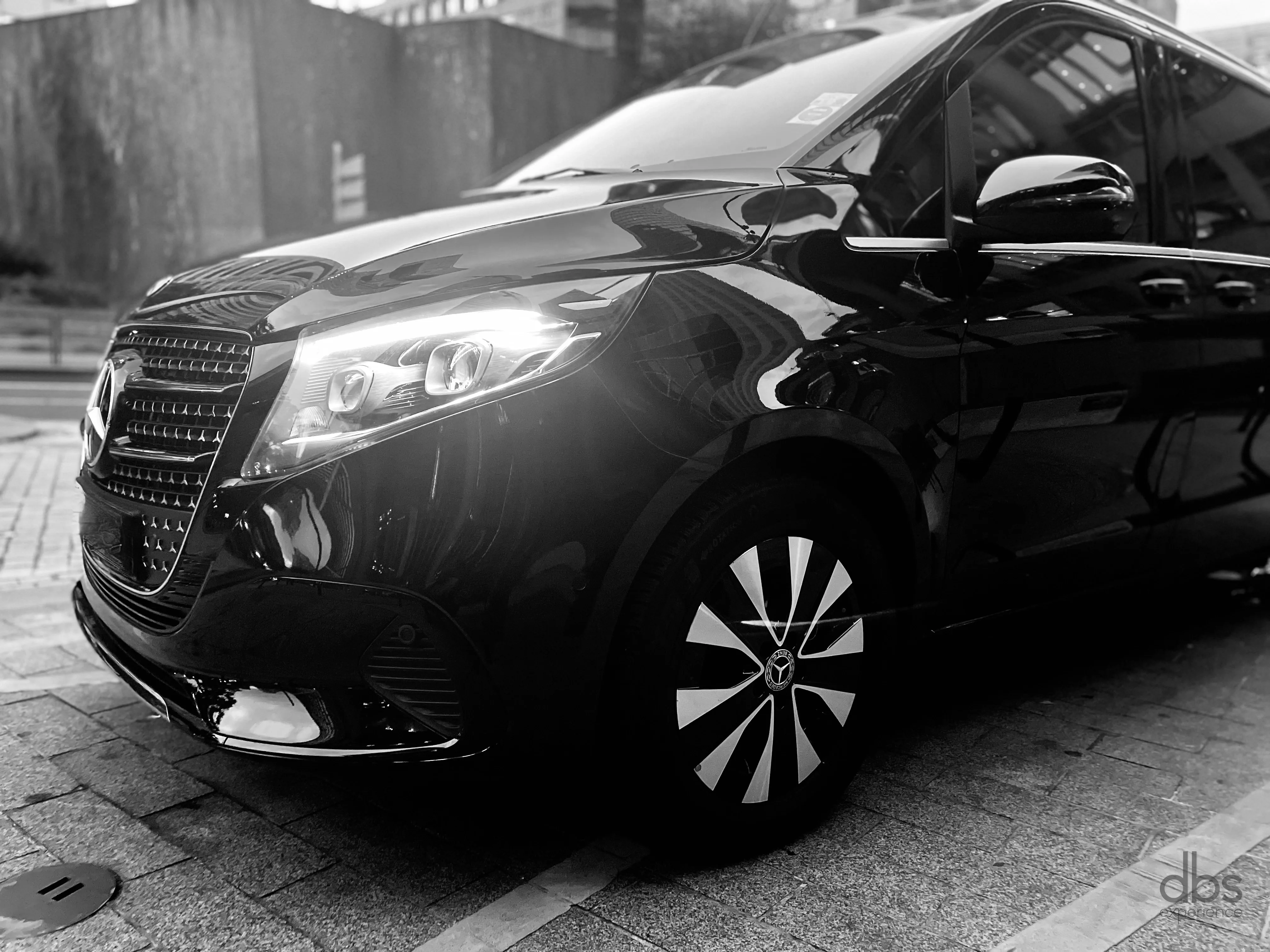
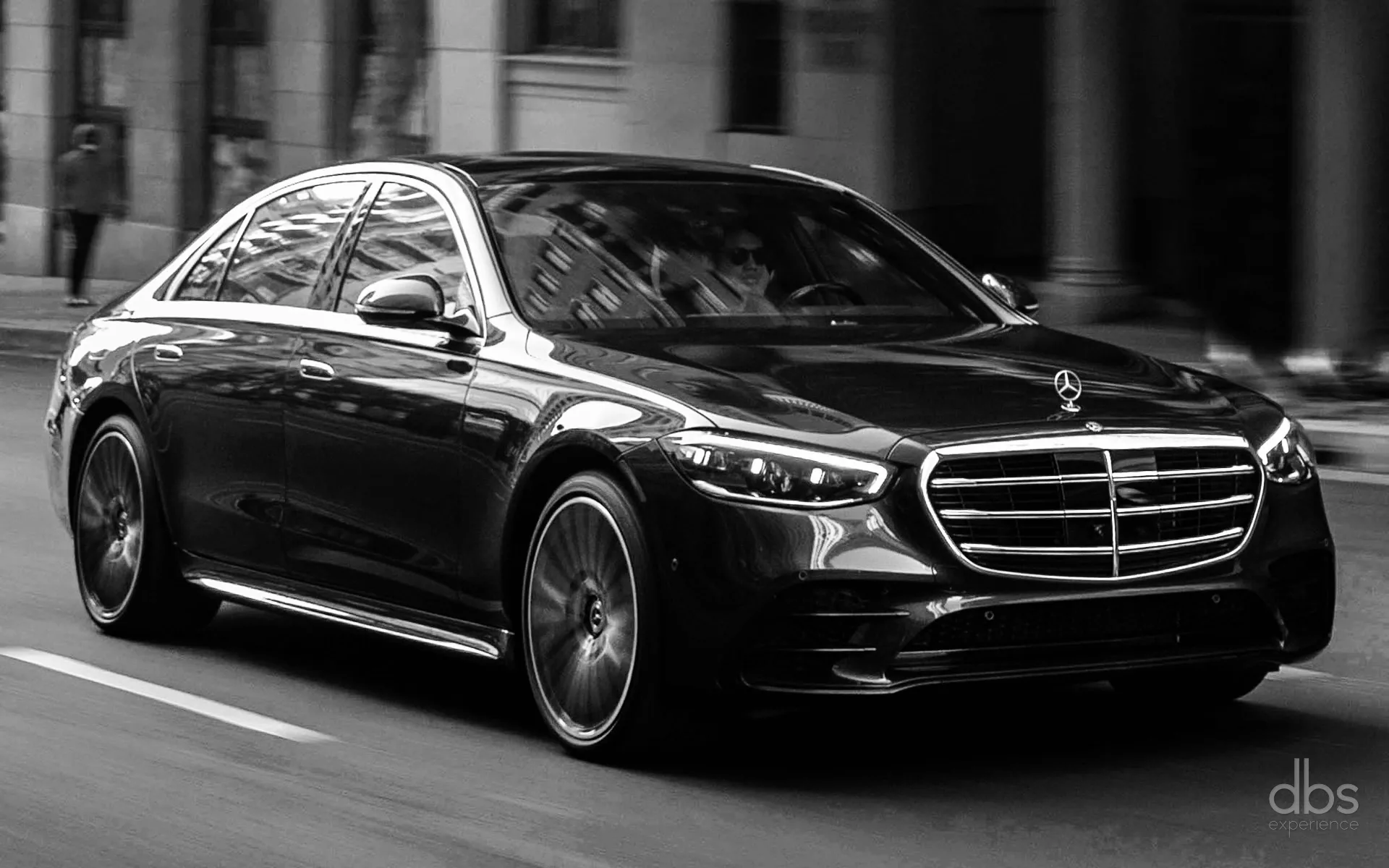
The vehicle follows the group, not the other way round. A single executive travelling with one adviser is best served by a Mercedes-Benz E-Class or, for a more senior presence, an S-Class. A team of up to seven travels together in a Mercedes-Benz V-Class, which matters on a roadshow because the time in the car is working time: the group debriefs the last meeting and prepares the next without breaking into separate vehicles. A larger delegation is carried in matched vehicles or a minibus so that everyone arrives together, which is part of the impression a roadshow is meant to make.
For a day built around a single moving base rather than a fixed route, an hourly chauffeur hire keeps one car and one chauffeur with the principal from the first meeting to the last, which is the simplest form a roadshow can take.
What roadshow transport costs
Roadshow transport is priced at disposal, by the hour and by the vehicle, which is the honest way to cost a day with no fixed route. There is a four-hour minimum and 20 km are included per hour, enough for a full day of city meetings. Rates start from €110 per hour in a Mercedes-Benz E-Class, from €135 per hour in a V-Class for a team, and from €160 per hour in an S-Class for a senior presence, with tolls and parking included. Once the schedule is known, the day is quoted as a fixed figure rather than a meter, so the cost is a decision taken in advance rather than a surprise at the end. Multi-day and multi-city programmes are built and quoted as one plan.
Choosing the format: half day, full day or multi-day
Most roadshows fall into one of three shapes. The table sets out how each is usually arranged.
| Format | Typical use | How it is arranged |
|---|---|---|
| Half day | A morning or afternoon of three to four meetings | One vehicle at disposal, four-hour minimum, fixed quote |
| Full day | A complete day of meetings across the city | One vehicle and chauffeur held door to door, quoted per day |
| Multi-day | A programme over several days, one or more cities | Consistent vehicles and chauffeurs, one account, one statement |
| Team roadshow | A delegation moving together | Matched vehicles or a minibus, coordinated arrivals |
The right format is a decision about the group and the agenda, not about the car. What stays constant is that one plan covers the whole programme, and one person holds it from the first meeting to the last.
The arrival that starts the roadshow
A roadshow often begins at the airport, and the first leg sets the tone for the rest. When a principal lands the night before or on the morning of the first meeting, the same operation that runs the day meets the flight, so there is no handover between an airport transfer and the roadshow car. The detail of a tracked, met arrival is covered in our guide to the CDG airport chauffeur transfer, and the roadshow simply continues from there, briefed and uninterrupted. The full service, with vehicles, coverage and the account structure, is set out on our roadshow transportation page.
Key Takeaways
- ✦A roadshow is booked at disposal for the whole programme, not leg by leg, so the day follows the agenda.
- ✦One managed account gives a single point of contact, consistent chauffeurs and one consolidated statement.
- ✦The schedule is read backwards from the last meeting, with realistic buffers for Paris business geography.
- ✦The fleet follows the group: an E-Class or S-Class for one, a V-Class for a team, matched vehicles for a delegation.
- ✦Pricing is at disposal from €110 per hour, four-hour minimum, quoted as a fixed day rate with tolls and parking included.