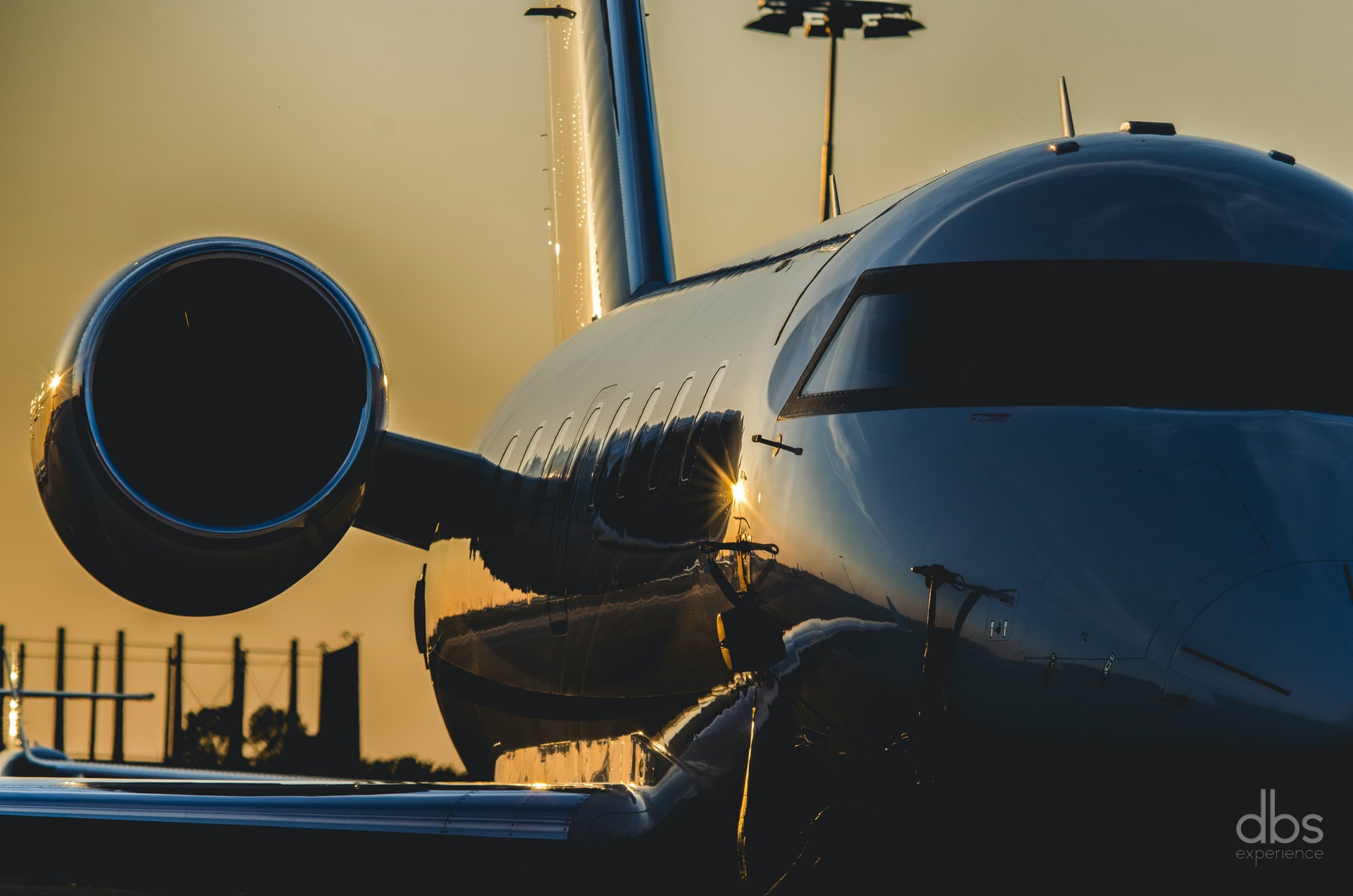
In short: how does a chauffeur transfer from a private jet at Le Bourget work?
The chauffeur waits at the FBO terminal handling your aircraft, and at most FBOs the car is cleared onto the ramp to meet the jet beside the air-stairs. Luggage moves from the hold straight to the boot, and the drive into Paris, 10 to 12 km south, begins within minutes of the engines stopping.
A private jet removes the public airport from the journey, and the ground transfer should match that standard rather than undo it. Le Bourget is built for exactly this: it is a business aviation airport, not a passenger one, and the arrival turns on the FBO, the ramp and the slot rather than the terminal, the queue and the carousel. For a principal stepping off a Falcon or a Global at eight in the morning, the car at the foot of the air-stairs is not a luxury but the logical continuation of the flight.
This guide sets out how a Le Bourget private jet transfer actually works, with the distances, the clearance times and the coordination a flight department, an executive assistant or a charter broker needs to brief a chauffeur. DBS EXPERIENCE has handled private aviation arrivals in Paris since 2009, over more than 25,000 journeys, and the detail below reflects how Le Bourget runs on the ramp, not how a schedule suggests it should.

Why Le Bourget is a different kind of arrival
Le Bourget is Europe's busiest business aviation airport, and it has carried no scheduled airlines since 1981. It handles private, charter and cargo flights only, which changes the character of the arrival completely. There is no main hall, no baggage carousel and no taxi rank. Instead there are fixed-base operators, the FBOs, each running its own private terminal and lounge, where crew and passengers are received, cleared and sent on their way. The airport sits about 10 to 12 km north-east of central Paris, closer to the city than Charles de Gaulle, and its landing and handling fees are lower than the larger northern gateway.
For the passenger, the practical difference is time. Customs and immigration are handled at the FBO, usually in five to ten minutes, often at the aircraft itself, rather than in a public terminal where a non-Schengen arrival can cost half an hour. The whole point of flying private is preserved on the ground, provided the chauffeur is coordinated with the FBO before the wheels touch. Our private aviation chauffeur service is built around that single idea.
Reading the FBO: where your jet actually arrives
At a commercial airport the question is the terminal. At Le Bourget it is the FBO. Several operators share the field, among them Signature, Jetex, ExecuJet and Universal Aviation, and the aircraft is assigned to one of them by the handler rather than by the destination. Each FBO has its own terminal building, its own lounge and its own ramp access, so the chauffeur needs the FBO name, not just the airport, to be in the right place.
This is the single most useful piece of information a flight department can pass on. With the FBO confirmed, the chauffeur arranges the ramp pass with that handler, positions the car at the correct terminal and meets the aircraft at the published slot. Without it, the car waits at the wrong building while the principal waits at another. The same discipline applies to a scheduled arrival, covered in our guide to the Le Bourget airport transfer.
Where the chauffeur meets you: planeside or in the lounge
At most Le Bourget FBOs the chauffeur can be cleared onto the ramp, which means the car waits beside the air-stairs as the aircraft shuts down. Luggage moves from the hold to the boot, and the passenger steps from the cabin to the car without entering a building. Where ramp access is not granted for a given movement, the chauffeur meets the passenger inside the FBO lounge, a few steps from the aircraft, with the same name board and the same assistance with bags. Either way, there is no walk through a public hall and no search for a car in a crowded lane.
How long the transfer really takes
Le Bourget sits roughly 10 to 12 km north-east of central Paris. In normal conditions the drive into the city is 20 to 35 minutes, shorter than the run from Charles de Gaulle. Early in the morning it can be closer to 20 minutes; during the morning and evening peaks, or on a day with a major event, it can reach an hour. The business districts of the 8th, the Champs-Élysées and the Opéra quarter are the quickest to reach, while La Défense, on the far north-western side, runs a little longer. For a passenger connecting to a scheduled flight, Charles de Gaulle is only 10 to 15 minutes further north.
These are ranges, not promises, which is precisely why the arrival is planned around the slot. A chauffeur who tracks the aircraft adjusts the pick-up to the actual landing time, checks live conditions before setting off and chooses the route that fits the hour. When a principal has a nine o'clock meeting after an eight o'clock landing, the plan accounts for clearance at the FBO, the ramp, the road and a margin, which means the arrival time becomes a decision rather than a hope.
Customs, immigration and the five-minute clearance
Le Bourget operates 24/7, and customs and immigration clear at the FBO rather than in a public terminal. For most arrivals the formalities take five to ten minutes, sometimes completed at the aircraft, with the general declaration handled by the handler. A non-Schengen arrival still passes immigration, but at the FBO desk rather than in a queue of several hundred. Slots are required for every movement, and noise rules restrict jet departures overnight, which is why the ground plan is built backwards from a confirmed slot rather than a rough hour.
Choosing the vehicle for a private-aviation arrival
The right car depends on the party, the luggage and the standard expected at the arrival. The table below sets out the realistic picture for a Le Bourget transfer into Paris.
| Vehicle | Passengers | Best for | From |
|---|---|---|---|
| Mercedes E-Class | 1–3 | A single executive or a pair, light luggage | €285 |
| Mercedes V-Class | 4–7 | A small team or extra luggage from the hold | €345 |
| Mercedes S-Class | 1–3 | The presence expected at a senior arrival | €425 |
| Range Rover Vogue | 1–3 | A discreet, elevated arrival | €520 |
For a larger group stepping off a single aircraft, a pair of V-Class vans usually serves better than one oversized vehicle, keeping luggage and passengers together without crowding. Whatever the choice, the fare is fixed and confirmed in advance, and the standard of the car is set rather than left to chance.

What a Le Bourget chauffeur transfer costs
Transparency on price is part of a professional arrangement, and here are the figures. A private chauffeur transfer between Le Bourget and Paris starts from €285 in a Mercedes-Benz E-Class, from €345 in a Mercedes-Benz V-Class for a small team or extra luggage, from €425 in an S-Class for the presence expected at a senior arrival, and from €520 in a Range Rover Vogue. The fare is fixed against your flight before the day, with no meter and no surge pricing, and it includes flight tracking and a period of complimentary waiting time, which means a slot change or a delayed landing does not become a lost booking.
Building the arrival around the slot
For a smooth arrival, work backwards from the first commitment. A typical morning arrival with a mid-morning meeting looks like this:
- On landing: the chauffeur is already at the FBO, alerted by flight tracking to the actual arrival time, with the ramp pass arranged.
- Clearance at the FBO: customs and immigration in five to ten minutes, often at the aircraft, bags received by the handler.
- Ramp to car: a few steps from the air-stairs, or from the lounge, with luggage carried to the boot.
- Road into Paris: 20 to 35 minutes to the centre, a little more to La Défense, chosen against live conditions.
- Margin: a reserve of 15 minutes to keep the arrival time comfortable, not tight.
The lesson is simple. At Le Bourget the clearance is quick and the road is short, so the variable that catches people out is coordination with the FBO. A plan that confirms the handler, the ramp and the slot keeps the first meeting calm.
Beyond the tarmac: the connected arrival
An arrival by private jet is often the first leg of a dense programme, and the value of a chauffeur grows when the day continues. The same vehicle and, where possible, the same chauffeur can hold for a morning of meetings, move between offices in the 8th and at La Défense, and return to Le Bourget for the evening departure. For a full business day, an hourly chauffeur hire keeps one car and one chauffeur with you from the ramp to the last meeting. For the fixed detail of vehicles, ramp access and fares at this airport, our Le Bourget private aviation transfer page sets it out in full, and for a scheduled arrival through the northern gateway our guide to the CDG airport chauffeur transfer covers the same ground.
Key Takeaways
- ✦Le Bourget is Europe's busiest business aviation airport, 10 to 12 km north-east of Paris, with no scheduled airlines.
- ✦The arrival turns on the FBO, not a terminal; share the FBO name so the car waits at the right building.
- ✦At most FBOs the chauffeur meets the jet planeside on the ramp; otherwise in the FBO lounge, a few steps away.
- ✦Customs and immigration clear at the FBO in five to ten minutes; the drive into Paris is 20 to 35 minutes.
- ✦A private transfer starts from €285, fixed in advance, with flight tracking and waiting time included.