In short: what is the best way to get from Le Bourget to Paris after a private flight?
For a private-jet arrival, a pre-booked chauffeur coordinated with your FBO is the natural choice. Le Bourget lies roughly 12 to 15 km north-east of central Paris, a 20 to 35 minute drive in clear conditions, though rush hour and major international events can stretch it to an hour or more. The car meets the aircraft planeside through the handling terminal, the flight and the slot are tracked, and the fare is fixed, so the arrival continues the flight rather than opening a fresh queue on the ground.
Le Bourget is not an airport in the sense that Charles de Gaulle or Orly are. It is Europe’s leading business aviation airport, given over entirely to private and business flights, with no scheduled commercial service and no vast public terminals. For a principal stepping off a private aircraft, the arrival is already more composed than at a commercial gateway; the role of the ground transfer is to protect that composure, not to rescue it. This guide sets out how a Le Bourget arrival actually works, with the distances, the timings and the practical detail a travel manager, an executive assistant or a flight department needs to brief a principal landing privately in Paris.
DBS EXPERIENCE has run executive and private-aviation arrivals across Paris since 2009, over more than 25,000 journeys, and the guidance below reflects how Le Bourget behaves in practice, coordinated with the FBOs rather than read off a schedule board.
Le Bourget is a different kind of airport
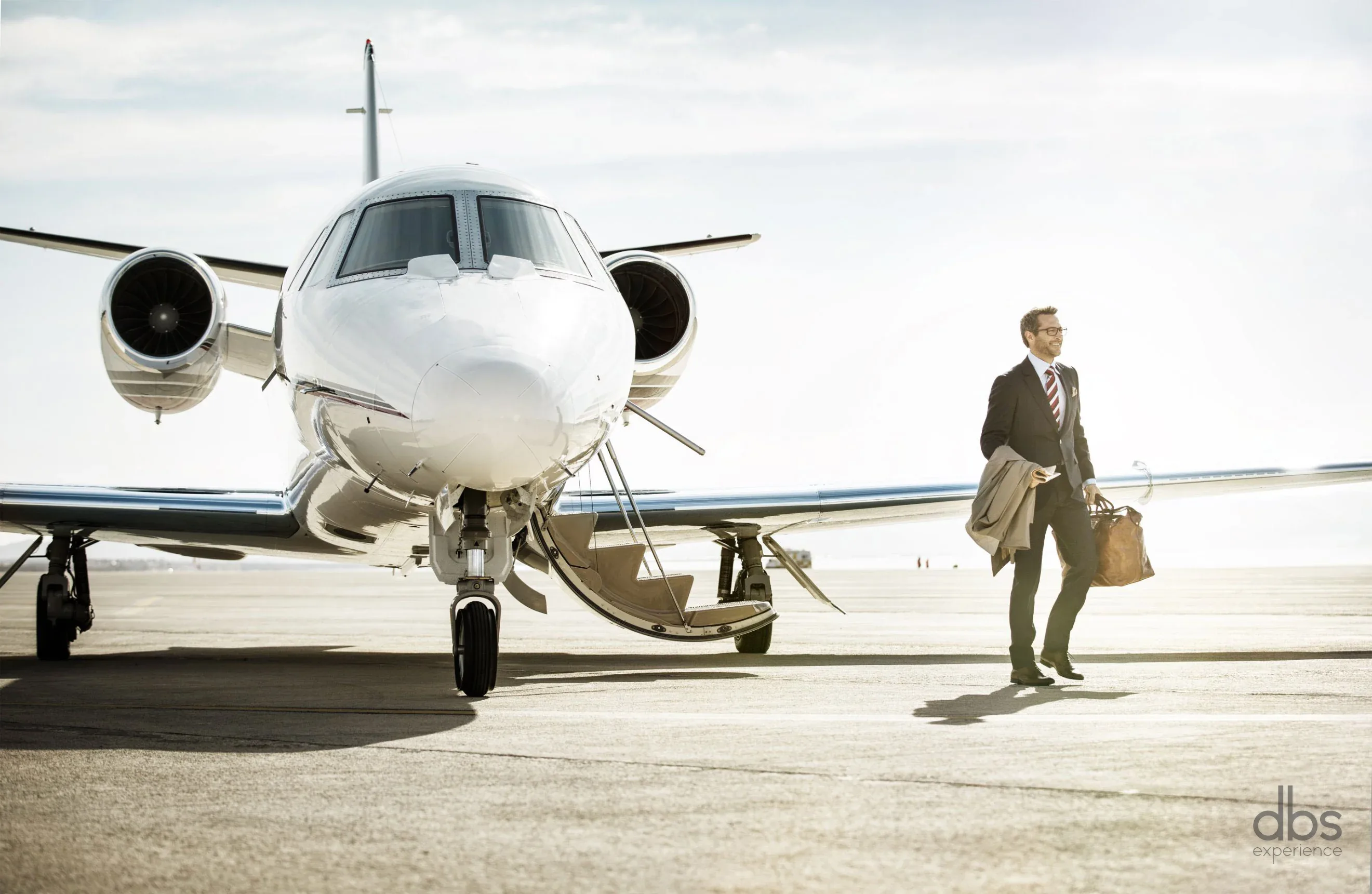
Paris–Le Bourget, operated by Groupe ADP, is the historic home of French aviation and today the busiest business aviation airport in Europe. It handles private jets, business aircraft and flight departments, not airlines, which changes the entire shape of an arrival. There are no baggage carousels shared with hundreds of passengers, no immigration hall the length of a concourse and no taxi rank. Instead, each aircraft is received by an FBO, the fixed-base operator that runs the private terminal, handles the aircraft on the ground and looks after the passengers from the moment the door opens.
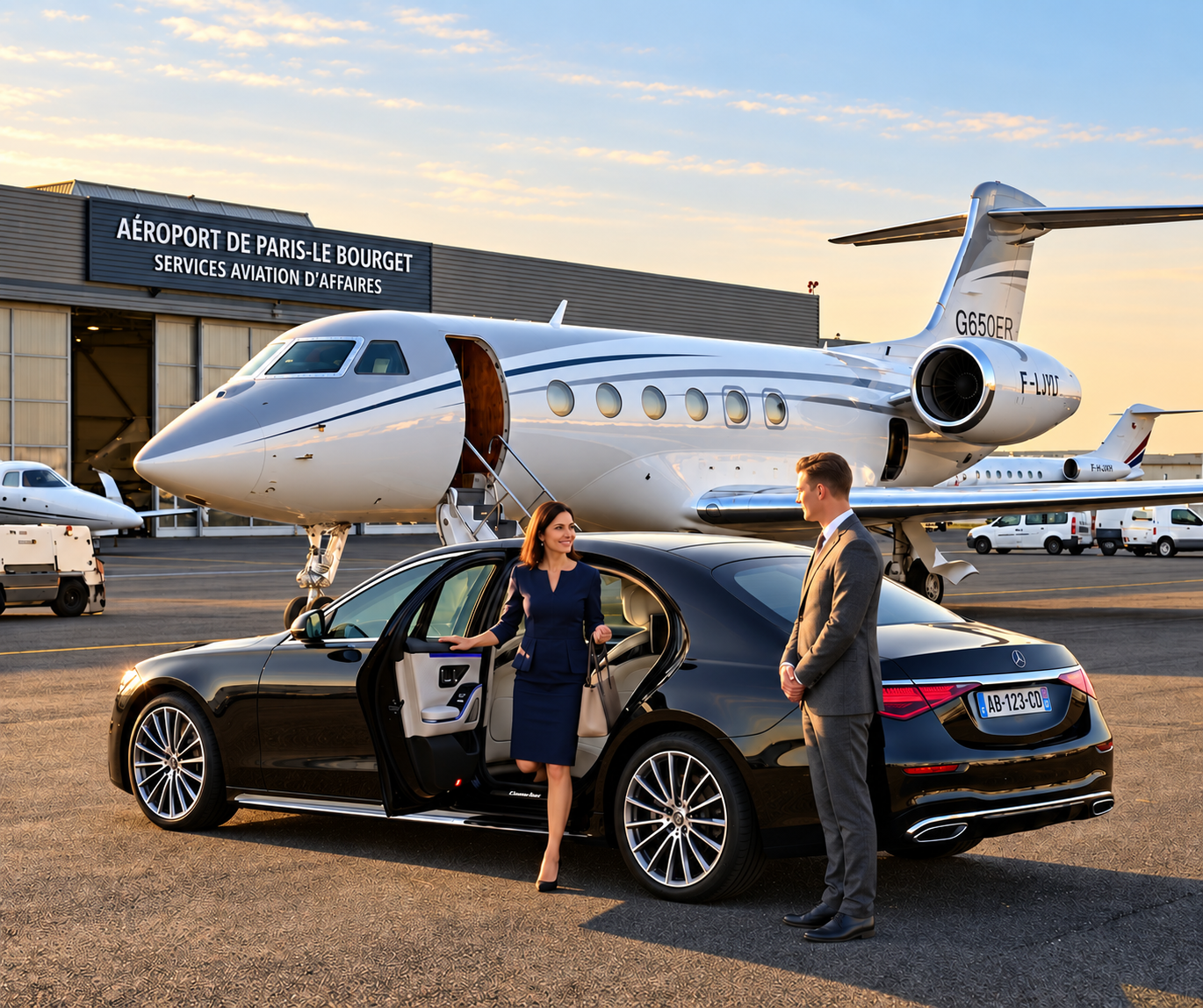
For the ground transfer this matters a great deal. The chauffeur does not wait in a public hall; the car is coordinated with the FBO and positioned beside the handling building, often only metres from the aircraft steps where access rules allow. Where customs or immigration apply, for a non-Schengen arrival, they are handled discreetly inside the FBO rather than in a public queue. The full detail of how we work planeside sits on our private aviation chauffeur page, and the vehicles and fixed fares are set out on our Le Bourget chauffeur transfer page.
Where the chauffeur meets you, and why it matters
At Le Bourget the meeting point is decided with your handler before the day. The chauffeur arrives ahead of the slot, checks in with the FBO and holds the car beside the terminal; when the aircraft is on blocks, the step from cabin to car is a short, private walk rather than a march through a building. Luggage goes straight from the hold to the vehicle. There is no name board held up in a crowd because there is no crowd, only the quiet handover a private arrival is meant to be.
This is also where coordination earns its place. A private slot can move; a handler can change stand; a passenger list can grow at the last minute. A chauffeur who is in direct contact with the FBO absorbs those changes without a call to the principal, which is the difference between a service that is merely booked and one that is actually managed.
What a specialist private-aviation chauffeur actually adds
At this level the car is a given; the value is in everything around it. A specialist private-aviation chauffeur service adds, concretely:
- FBO liaison. The chauffeur checks in with your handler, confirms the stand and the meeting point, and repositions if the stand changes, so nothing lands on the passenger.
- Flight and slot tracking. The car is timed to the actual on-blocks, not a printed ETA; a slot that slips simply moves the pick-up rather than losing it.
- Planeside or terminal access where the airport and handler permit it, so the walk from the steps to the car is measured in metres, not corridors.
- One named point of contact who holds the plan end to end, instead of a different number for each leg of the day.
- Discretion as standard. Vetted, bilingual chauffeurs used to recognisable principals, with confidentiality taken as read.
- Continuity. The same vehicle, and where possible the same chauffeur, for the arrival, the day’s meetings and the departure.
- One account, one invoice. Corporate accounts, duty-of-care reporting and a single monthly statement for travel managers and flight departments.
How long the transfer really takes
Le Bourget sits roughly 12 to 15 km north-east of central Paris by road, which makes it the closest Paris airport to the city for most arrivals. In clear conditions the drive into the centre is 20 to 35 minutes, shorter than either commercial gateway. The caveat is traffic: the A1 and the ring road, the périphérique, are among the busiest in Europe, and at the morning and evening peaks, or during a major international event such as the Paris Air Show, a large trade fair or a summit, the same short distance can take an hour, sometimes an hour and a half. The north-eastern approach favours the 8th, the 9th, the business district around Opéra and the Right Bank, while La Défense, to the west, runs longer.
These are ranges, not promises, which is why the arrival is timed from live conditions rather than a map, and why a margin is built in rather than hoped for. A chauffeur who tracks the aircraft adjusts the pick-up to the actual arrival, checks live traffic before setting off and chooses the route that fits the hour. The same discipline we apply at the commercial gateways, set out in our guides to the CDG airport chauffeur transfer and the Orly airport chauffeur transfer, applies at Le Bourget, with the added advantage that there is no terminal to cross on foot.
How the ground options really compare
After a private flight the realistic question is not whether to take the train; it is how well the car on the apron is coordinated. The table below compares the ground options a flight department actually weighs for an arrival at Le Bourget.
| Option | Typical time | Indicative cost | Best for |
|---|---|---|---|
| DBS private chauffeur | 20–35 min* | From €285, fixed | A jet arrival: planeside at the FBO, flight- and slot-tracked, one named contact |
| Chauffeur booked without FBO liaison | 20–40 min | Variable | A car on the day, met at the car park, with no airside coordination |
| Official taxi from the FBO | 25–40 min | Metered | A fallback ride: no flight tracking, no planeside hand-off |
| Handler courtesy car, where offered | — | Included, limited | Short hops on the airport, not a transfer into Paris |
*In clear conditions; allow an hour to an hour and a half at peak or during a major event.
The honest conclusion is that the car is the easy part and the coordination is what separates the options. A taxi, or a car booked without liaison, will still reach Paris, but it meets you at the forecourt or the car park, keeps a meter running or an uncertain price, and leaves you to find it when a slot slips. A chauffeur coordinated with your FBO is timed to the aircraft, positioned planeside where access allows, and held against a fixed fare, so the ground leg is simply the next quiet stage of the journey. For an arrival whose whole purpose is to protect a principal’s time, that difference is the service.
What a Le Bourget executive transfer costs
Transparency on price is part of a professional arrangement, and here are the figures. A private chauffeur transfer between Le Bourget and Paris starts from €285 in a Mercedes-Benz E-Class, from €345 in a Mercedes-Benz V-Class for a small team or extra luggage, from €425 in an S-Class for the presence expected at a senior arrival, and from €520 in a Range Rover Vogue. The fare is fixed against your flight before the day, with no meter and no surge pricing, and it includes flight tracking and a period of complimentary waiting time, so a change to the slot does not become a lost booking. For a crew or a larger party arriving together, a dedicated van keeps the group in one vehicle.
Building in margin: the arrival timeline
For a smooth arrival, work backwards from the first commitment. A typical private arrival with an onward meeting looks like this:
- Before the slot: the chauffeur is already at the FBO, in contact with the handler and alerted by flight tracking to the actual arrival time.
- On blocks: the car is positioned beside the terminal; for a Schengen arrival the handover is immediate, for a non-Schengen one customs is cleared discreetly inside the FBO.
- Aircraft to car: a short private walk with luggage carried, measured in metres rather than minutes.
- Road into Paris: 20 to 35 minutes to the centre in clear conditions, an hour or more at peak or during a major event, a little longer to La Défense, chosen against live traffic.
- Margin: a reserve sized to the hour and the day’s traffic, so the arrival time stays comfortable rather than tight.
The lesson is simple. At Le Bourget the terminal is no longer the variable; the only things left to manage are the slot and the road, and both are handled by coordination rather than luck.
Beyond the tarmac: the connected arrival
A private arrival is usually the first leg of a compressed, high-value day, and the chauffeur’s value grows when the day continues. The same vehicle and, where possible, the same chauffeur can hold for a morning of meetings, move between offices in the 8th and at La Défense, and return you to the aircraft in the evening. For a full business day, an hourly chauffeur hire keeps one car and one chauffeur with you from the terminal to the last meeting, and a multi-city itinerary runs as a roadshow transfer. For a flight department or a travel manager, the whole programme runs on a corporate account, with duty-of-care reporting and a single invoice. Le Bourget is also the home of the biennial Paris Air Show, next held in June 2027, when the airport and its approaches run at their busiest and planning the arrival well ahead is no longer optional.
Key Takeaways
- ✦Le Bourget is Europe’s leading business aviation airport, for private jets only, 12 to 15 km north-east of Paris.
- ✦Plan 20 to 35 minutes by road in clear conditions, but allow an hour to an hour and a half at peak and during major international events.
- ✦The chauffeur is coordinated with your FBO and meets you planeside; there is no public hall and no taxi rank.
- ✦The value is coordination, not just the car: FBO liaison, flight and slot tracking, one named contact, discretion and continuity.
- ✦A private transfer starts from €285, fixed in advance, with flight tracking and waiting time included.